Flow
Also known as Numberlink, Arukone and Dot Connect
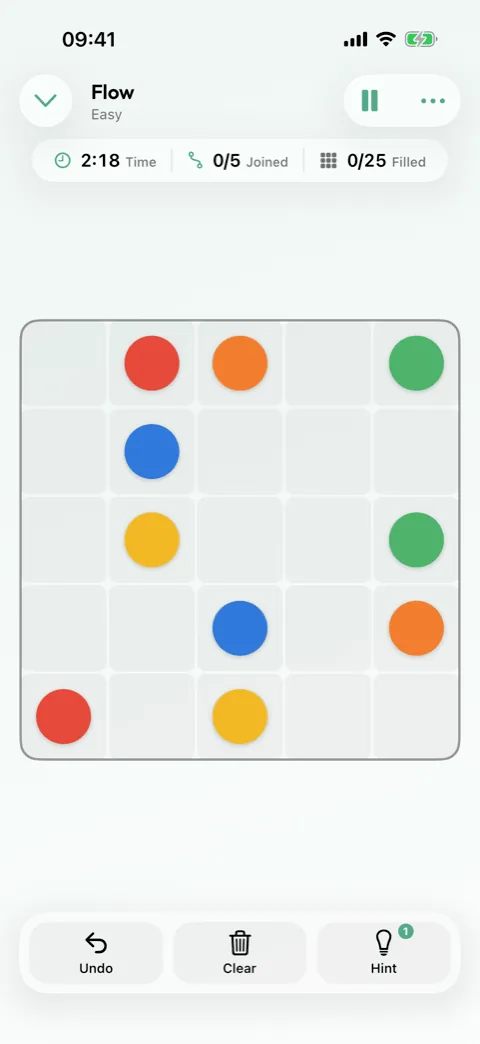
Every colour appears as two dots. Join each pair with a path, without letting the paths cross — and fill the whole grid while you do it. Easy to pick up in one look, and surprisingly tight once the board gets bigger.
How it works
- Every colour appears as two dots. Drag from one to the other to join them.
- Fill the whole grid. Every square must end up on some path.
- Paths can't cross or share a square, and can't run through another colour's dot.
- Drag back along a line to shorten it, or across another colour to take its square.
Good if you want…
- Understanding the whole puzzle in one glance
- Two minutes on a small board or longer on a big one
- No reading and no arithmetic
How to solve Flow
Start at the edges and corners
A pair of dots that both sit on the edge of the board can usually be joined by running along that edge, and a path along the edge rarely gets in anyone else's way. Corners are even better: a dot in a corner has only two ways out, which makes its path much easier to predict.
Join the short, obvious pairs
Two dots next to each other, or one square apart, are almost always joined directly. Connect them early and they stop being something you have to think about.
Hug the walls and each other
Good paths run alongside something — the edge of the board, or another path. A path that wanders through open space tends to cut the board into pieces that cannot be filled. When in doubt, route a line so it touches as many already-settled squares as possible.
Watch for stranded squares
Every square on the board must end up on some path. If a move leaves an empty square boxed in by other colours, with no way for any path to reach it, the move is wrong. Likewise a path that doubles back on itself, filling a two-by-two block with one colour, is almost always a mistake — that space was meant for something else.
Take squares back freely
Dragging back along a line shortens it, and dragging across another colour takes its square. Nothing is lost by redrawing, so treat early lines as sketches and adjust as the board fills.
Common mistakes
- Joining every pair and forgetting to fill the board. The puzzle is only finished when every square is covered.
- Starting with the longest path. The short, constrained pairs tell you where the long ones can go.
Where Flow comes from
Puzzles of this kind are known as Numberlink or Arukone, and they have been published in Japanese puzzle magazines for decades, with numbers where the coloured dots are here.
Flow questions
Can two paths cross?
No. Paths cannot cross, share a square or run through another colour's dot.
Do I have to fill every square?
Yes. Every square must end up on a path for the board to be solved.
Flow in Winters Puzzles
Flow is one of 40 puzzles in Winters Puzzles, so it sits alongside Tessera, Ripple, Shift and everything else in the app rather than being a download of its own. It counts towards your stats and streak like any other puzzle. It is not one of the puzzle types included in Pip’s dailies.
Play Flow.
Free on iPhone and iPad, with 39 other puzzles alongside it. Or play it in your browser — no download, nothing to sign up for.