Cascade
Also known as Match Three and Match 3
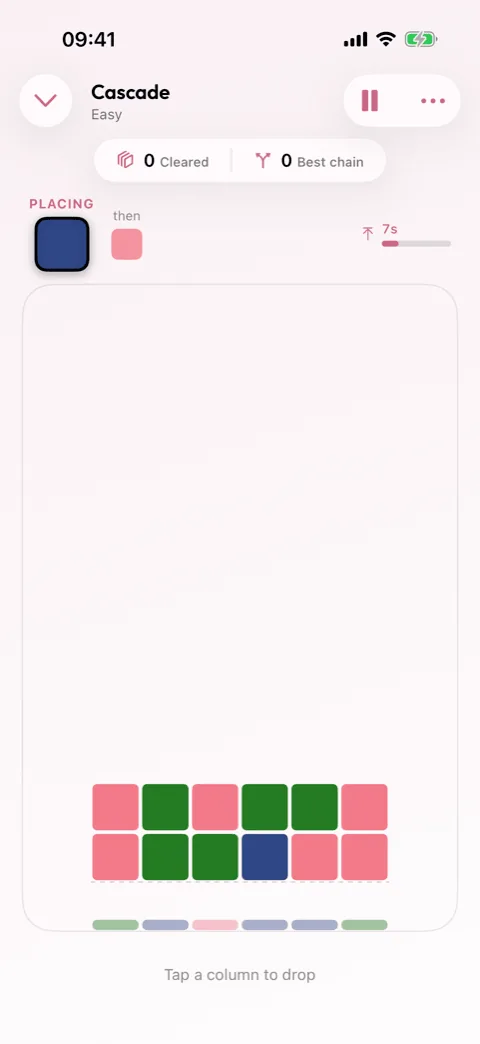
Drop blocks into columns and line up three of a colour to clear them. What sat above falls into the gap, and a fall that completes another line clears too — so a well-set board pays off in chains. A new row pushes up from the floor on a timer, and every clear brings the next one sooner.
How it works
- Tap a column to drop the waiting block into it.
- Three of a colour in a row or column clears them, and whatever sat above falls into the gap.
- A fall that completes another line clears too, so a well-set board pays off in chains.
- A new row pushes up from the floor on a timer, and every clear brings the next one sooner.
- Your score is the blocks cleared. Fill the board with nowhere left to place and the round ends.
Good if you want…
- Setting up a chain and watching it go
- Pressure that builds rather than a fixed clock
- A puzzle game with a score attached
How to get better at Cascade
Set up chains
When three of a colour clear, whatever sat above falls into the gap, and a fall that completes another line clears too. So look for places where a clear will drop a block into line with two others of its colour. A board built for chains clears far more per drop than one cleared piece by piece.
Keep the columns level
A new row pushes up from the floor on a timer, and the round ends when there is nowhere left to place. A single tall column is the usual way that happens. Spread blocks across the board rather than stacking them where they happen to match.
Clear to buy time
Every clear brings the next rising row sooner, so clearing is not only about score — it is about height. When the board is getting high, take any clear you can, even a small one, before trying anything ambitious.
Choosing a speed
The tiers change how many colours there are, how often a new row rises and how full the board is when you start. The gentlest tier deals three colours with two rows on the board and a slow rise; the hardest deals six colours, starts with five rows already down, and pushes new rows up far more often.
Fewer colours means matches are easy to make and chains happen almost by accident, which makes the gentle tier a good place to learn how falls set up further clears.
Read the waiting block
The block waiting to drop is the only one you control, so every drop is a choice between columns. Before dropping, look along each column top for a colour that matches — and also at what sits beside it, since three in a row across counts as well as three stacked up. A drop that makes a line of two with a gap for a third is often better than an immediate clear, when the board is low enough to afford it.
Plan the fall
When a line clears, only the blocks above it move. So the best chains are set up by stacking a colour above a line you are about to complete, with its partners waiting one row down. It takes practice to see, but once you start noticing that shape you will find chains of two and three clears turning up regularly.
Common mistakes
- Building one tall column of matches that never quite line up.
- Ignoring the rising floor while setting up a perfect chain.
Cascade questions
Do lines count diagonally?
No. Three of a colour in a row or a column clears; diagonals do not.
How is Cascade scored?
By the number of blocks cleared.
Cascade in Winters Puzzles
Cascade is one of 40 puzzles in Winters Puzzles, so it sits alongside Runner, Tower Stack, Threader and everything else in the app rather than being a download of its own. It counts towards your stats and streak like any other puzzle. It is not one of the puzzle types included in Pip’s dailies.

Play Cascade.
Free on iPhone and iPad, with 39 other puzzles alongside it. Or play it in your browser — no download, nothing to sign up for.