Lattice
Also known as Block Puzzle and Block Sudoku
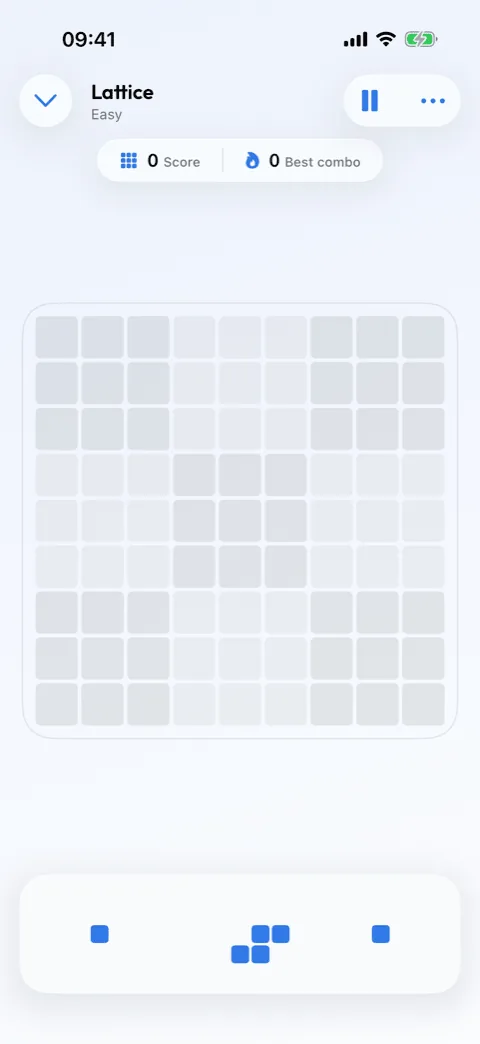
Shapes are dealt three at a time and you drop them onto the grid. Fill a row, a column or a box and it clears. The catch is the hand: you get the next three only once all three are placed, so a piece you cannot fit ends the round.
How it works
- Drag a shape from the tray onto the grid. A preview shows where it will land.
- Fill a whole row, column or 3×3 box and it clears away.
- Clearing several at once scores far more than clearing them one at a time.
- You are dealt three shapes and get the next three once all of them are placed — so plan the whole hand, not just the next piece.
- Every hand can be played.
- Your score is the points earned. The round ends when nothing in hand will fit.
Good if you want…
- Planning a few moves ahead
- A score to beat rather than a finish line
- No reading and no arithmetic
How to solve Lattice
Plan the whole hand
You get three shapes and no more until all three are placed. So before dropping the first, look for a spot for each of them. A shape that fits beautifully now can take the only space the third shape could have used, and a piece you cannot fit ends the round.
Keep room for the big pieces
The dangerous shapes are the large ones: the five-square straight lines and the big L-shaped corners that span three squares each way. Always keep somewhere on the board where they could still go — an empty row or column, or an open three-by-three area. A board of scattered small gaps can take any number of single squares and none of the big pieces.
Clear several at once
Clearing two or three rows, columns or boxes with one shape scores far more than clearing them separately. Build up lines that are nearly full, then look for the single piece that finishes several of them together.
Keep the board tidy
Fill from the edges and corners inward, and try not to leave single isolated holes. A hole surrounded on all sides can only ever be filled by a single square, and you cannot count on getting one.
Choosing a tier
The tiers change which shapes are dealt and how the score rewards you. On the gentlest tier the largest shapes are four squares and small pieces are common. On the harder tiers five-square lines and big L-shaped corners turn up much more often, and clearing several lines at once earns a bigger bonus. The shapes that can end a round are exactly the ones the harder tiers favour, which is why keeping space for them matters more as you move up.
Read the rows and boxes together
Every placement touches a row, a column and a three-by-three box at the same time. A good placement moves several of those towards being full at once; a poor one fills a square in a row that is otherwise empty and a box that is otherwise empty. When deciding between two spots, prefer the one that sits in lines you are already building.
Common mistakes
- Placing each shape in the first place it fits. Look at all three before placing any.
- Filling the centre of the grid early. Open space in the middle is the most flexible space there is.
Lattice questions
Can I rotate the shapes?
No. Each shape is placed the way it is dealt, which is why planning the hand matters.
Is every hand playable?
Every hand can be played on the board it was dealt to. What happens after that depends on where you put it.
Lattice in Winters Puzzles
Lattice is one of 40 puzzles in Winters Puzzles, so it sits alongside Tessera, Ripple, Flow and everything else in the app rather than being a download of its own. It counts towards your stats and streak like any other puzzle. It is not one of the puzzle types included in Pip’s dailies.

Play Lattice.
Free on iPhone and iPad, with 39 other puzzles alongside it. Or play it in your browser — no download, nothing to sign up for.