Kakuro
Also known as Cross Sums and Cross Addition
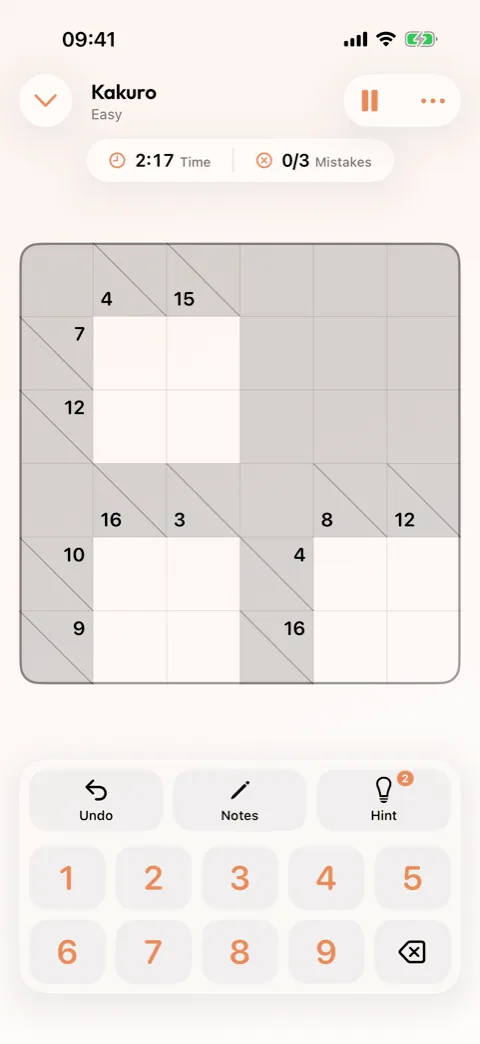
A crossword built from sums. Each run of white cells has to add up to the clue pointing at it, using only the digits one to nine and never repeating one inside the same run. Where the runs cross is where the puzzle gets solved.
How it works
- Each run of white cells must add up to the number pointing at it.
- A clue above the diagonal is for the run to its right; below is for the run beneath.
- Use 1–9 only, and never repeat a digit within the same run.
- Notes mode pencils in the candidates you're weighing up.
Good if you want…
- Proper deduction with numbers
- A puzzle that rewards knowing which sums are forced
- Something harder than a mid-difficulty Sudoku
How to solve Kakuro
Learn the forced combinations
Kakuro is solved by knowing which sums can only be made one way. Two squares that add to 3 can only be 1 and 2; two squares adding to 17 can only be 8 and 9. Three squares adding to 6 must be 1, 2 and 3, and three adding to 24 must be 7, 8 and 9. These runs are the openings of every board — the table below lists them, worked out rather than remembered.
You do not need the whole table by heart. The pattern is that the smallest and largest possible totals for any length are always forced, and so are the totals one step in from each end.
Solve where runs cross
A square belongs to one across run and one down run, and must satisfy both, so the digits it can hold are only those both runs allow. When the across run is a 7 in three squares (so 1, 2 and 4) and the down run allows only 4, 5 and 6, the crossing square is a 4, and both runs are one digit closer to done. A run of two adding to 16 (7 and 9) crossing a run of three adding to 24 (7, 8 and 9) leaves the crossing square a 7 or a 9 — not settled yet, but two options instead of nine.
Rule out, not just in
A run of two adding to 10 could be 1+9, 2+8, 3+7 or 4+6, but never 5+5. A run of four adding to 12 cannot include a 7, 8 or 9, because even 7+1+2+3 is 13. Asking "what is the largest digit this run could possibly hold?" trims candidates on every run, not just the forced ones.
Use notes for the middle
Once the forced corners are in, the middle of the board is usually a matter of candidates. Pencil in the options for the most constrained squares, fill a square the moment its across and down candidates share only one digit, and rework the runs it belongs to.
Totals that can only be made one way
| Run length | Total → the only digits that make it |
|---|---|
| 2 squares | 3 = 1 + 2 · 4 = 1 + 3 · 16 = 7 + 9 · 17 = 8 + 9 |
| 3 squares | 6 = 1 + 2 + 3 · 7 = 1 + 2 + 4 · 23 = 6 + 8 + 9 · 24 = 7 + 8 + 9 |
| 4 squares | 10 = 1 + 2 + 3 + 4 · 11 = 1 + 2 + 3 + 5 · 29 = 5 + 7 + 8 + 9 · 30 = 6 + 7 + 8 + 9 |
| 5 squares | 15 = 1 + 2 + 3 + 4 + 5 · 16 = 1 + 2 + 3 + 4 + 6 · 34 = 4 + 6 + 7 + 8 + 9 · 35 = 5 + 6 + 7 + 8 + 9 |
Common mistakes
- Repeating a digit within a run. 5 and 5 make 10, but a run never repeats a digit, so it is not an option.
- Reading the wrong half of a clue square. The number above the diagonal is for the run going right; the number below it is for the run going down.
- Starting in the middle. The forced runs are nearly always at the edges and corners, and the board unzips from there.
Where Kakuro comes from
Kakuro was published in the United States as Cross Sums from around 1950. The Japanese publisher Nikoli popularised it in the 1980s under the name Kakuro, a shortening of the Japanese for "addition cross", and it arrived in British newspapers in 2005 on the back of Sudoku's success.
Kakuro questions
Which digits can I use?
One to nine only — no zero — and no digit twice in the same run.
Do I need to be good at arithmetic?
Only at small sums. The skill is recognising which totals can only be made one way, and that comes quickly with practice.
What is a good first Kakuro?
An easy board in Winters Puzzles is small and leans on the forced combinations heavily, which makes it a good place to learn them.
Kakuro in Winters Puzzles
Kakuro is one of 40 puzzles in Winters Puzzles, so it sits alongside Sudoku, Nonogram, KenKen and everything else in the app rather than being a download of its own. It counts towards your stats and streak like any other puzzle. It also has a published board in Pip’s dailies, with earlier dates available in the archive.

Play Kakuro.
Free on iPhone and iPad, with 39 other puzzles alongside it. Or play it in your browser — no download, nothing to sign up for.