KenKen
Also known as Calcudoku, Mathdoku and Kendoku
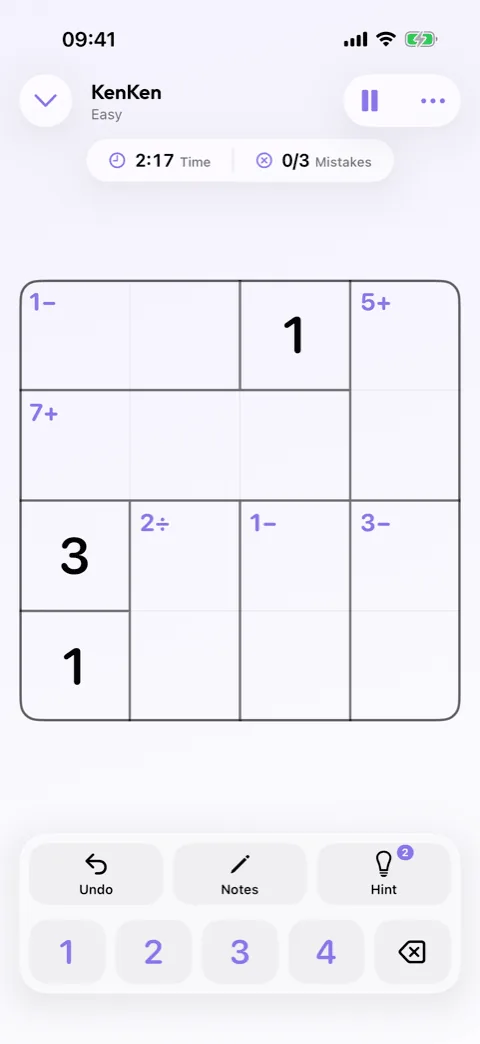
A Latin square with arithmetic on top. Fill each row and column with the numbers one to the board size, no repeats — but the heavy outlines mark cages, and the numbers inside each cage have to hit its target using the sign shown. It asks for a little mental arithmetic alongside the deduction.
How it works
- Fill each row and column with 1 to the board size, no repeats.
- Heavy outlines mark cages. The cells in a cage must produce its target.
- “6+” — add the cage values to make 6. “6×” — multiply them to make 6.
- “3−” — a two-cell cage whose values differ by 3; order doesn't matter.
- A cage with just a number and no sign is that value outright.
Good if you want…
- Sudoku-style deduction with arithmetic in it
- A smaller grid that still takes some working out
- Something a bit less familiar than Sudoku
How to solve KenKen
Take the free squares
A cage of one square with just a number in it is simply that number. Fill those in first, then clear that digit from the rest of the row and column in your head or in notes — on a small board that alone can settle several squares.
Let the cage type narrow things
Some targets allow only one pair of numbers. On a 6×6 board, a two-square "5−" cage must be 1 and 6, because those are the only digits five apart. A "30×" two-square cage must be 5 and 6. A "3÷" cage on a 6×6 board could be 1 and 3 or 2 and 6, which is two options rather than fifteen. Ask of every cage: which pairs, or triples, hit this target at all?
Multiplication cages are the most revealing, because of prime factors. A cage whose product is a multiple of 5 on a 6×6 board must contain the 5 — there is nowhere else a factor of 5 can come from.
Use the row totals
Every row and column holds each number once, so its total never changes: 10 on a 4×4 board, 15 on a 5×5, 21 on a 6×6. When a row is covered entirely by cages you know the sums of, except for one square, that square is the difference. This "rule of 21" on 6×6 boards finds squares that no single cage would ever give up.
Then treat it like Sudoku
Once cages have narrowed the candidates, the rest is Latin-square logic: a number that can only go in one place in a row goes there, and two squares in a column that can only be 2 or 4 between them use up the 2 and the 4. Pencil the candidates for each cage into its squares and look for these patterns exactly as you would on a Sudoku board.
Common mistakes
- Assuming the numbers in a cage must differ. They cannot repeat within a row or column, but an L-shaped cage spans two of each, so it can hold the same number twice.
- Forgetting that subtraction and division cages ignore order. "2÷" means one number is twice the other — which one is on the left is for the rows and columns to decide.
- Trying every combination for a big addition cage. Pin down the small, tight cages first and the big ones fill in around them.
Where KenKen comes from
The puzzle was devised in 2004 by the Japanese mathematics teacher Tetsuya Miyamoto as a way to teach arithmetic and logic together, and its name uses the Japanese word for cleverness. Versions of the same idea are published under several other names, including Calcudoku and Mathdoku.
KenKen questions
Is KenKen harder than Sudoku?
It is different rather than harder. The boards are smaller, but you are working with sums and products as well as placements. Many people find a mid-sized KenKen quicker than a hard Sudoku.
Can a number repeat inside a cage?
Yes, as long as the two copies are in different rows and different columns. That only happens in cages that bend round a corner.
What does a cage with no sign mean?
It is a single square, and the number is its answer.
KenKen in Winters Puzzles
KenKen is one of 40 puzzles in Winters Puzzles, so it sits alongside Sudoku, Nonogram, Kakuro and everything else in the app rather than being a download of its own. It counts towards your stats and streak like any other puzzle. It also has a published board in Pip’s dailies, with earlier dates available in the archive.

Play KenKen.
Free on iPhone and iPad, with 39 other puzzles alongside it. Or play it in your browser — no download, nothing to sign up for.